What Does a Physical Scale Mean in Renaissance Art
Proportion and scale are used extensively in architecture to create forms that are both functional and pleasing to the eye. Establishing a balance betwixt the two is what separates great architecture from other types of structures.
Designers use scale to create compositions that are advisable in size for the intended use and proportion them in such a way that the separate parts relate to one other, also as the whole of the edifice, in a harmonious and rational manner.
The aim of building pattern is to create a limerick that both inspires the senses and is, at the aforementioned time, organized in an identifiable and rational manner. While both scale and proportion impact the aesthetic quality of a edifice, they do so in different ways.
The Divergence Between Proportion and Scale
Scale typically refers to the size of an object or form relative to a standard of reference. The standard of reference tin be the overall composition or possibly an adjacent course. However, calibration is only a relative comparison of size.
Proportion, on the other hand, takes into business relationship the proper or harmonious relationship between shapes relative to one another or to the limerick as a whole. Proportion is concerned with both quality as well every bit the caste of accent or articulation.
In addition to design intent, in that location are other factors that can impact both scale and proportion. For example, the standard size of the materials used and structural requirement or constraints can also play a part.
Fabric Proportions
Materials, because of their inherent physical qualities have limitations in terms of size. Their force, rubberband qualities, hardness, and durability all limit how long, wide, or thick they tin can be earlier breaking or collapsing.
A textile's proportions are besides regulated past how they react to forces of stress. Some materials, such as brick, for example, perform better under compression. Their size and mass are dimensioned in such a manner every bit to take advantage of this natural quality.
Steel, on the other manus, is able to perform under both weather of tension and pinch. This provides the material with greater flexibility. It can be fabricated into linear shapes such as columns and beams, only at the same time, it can also be made into sheets of metal. Regardless, there are limits to its size and shape determined by its point of failure.
Wood is a adequately flexible and rubberband textile, and can also exist used for linear shapes such as posts and beams or as planar sheets.
Structural Proportions
Like to edifice materials, structural members are proportioned based on their functional requirements and strength limitations.
A beam, for example, has significantly more depth proportionally to its width. This allows it to bridge greater distances and support more weight.
A cavalcade, on the other hand, increases in thickness relative to the corporeality of weight it needs to support. Both structural elements offer cues on the size and proportions of the spaces they occupy.
Manufactured Proportions
Architectural elements are proportioned not only based on structural limitations simply can also be size based on manufacturing standards and norms.
These proportions are often dictated by convention, but other factors such as ease of transport and packaging efficiency can also come into play since the elements are produced in manufacturing plants.
Because these manufactured products function in combination with other elements of a edifice, often as well manufactured in a constitute, their size and proportions are also established based on their human relationship to those other parts. How they fit in the overall assembly, for case.
An case of this are doors and windows, which are required to fit within modular masonry openings. Likewise, sheathing materials are sized to fit within the standard spacing requirements of wood and metal studs and joists.
Proportioning Systems
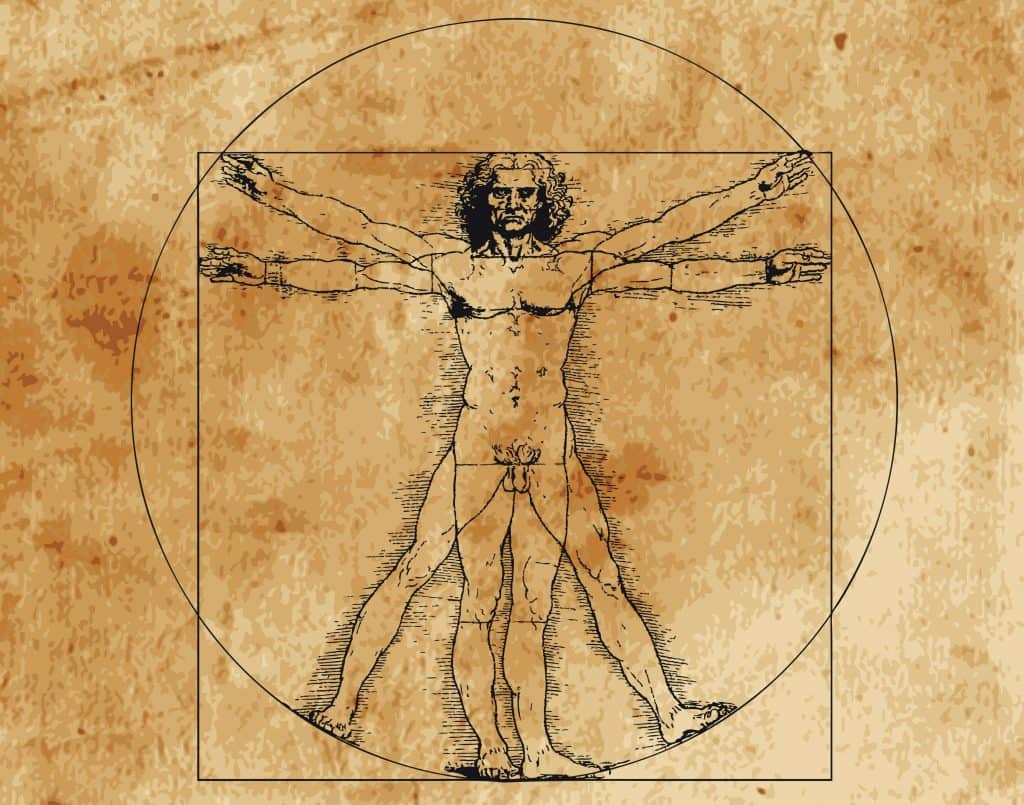
While the size of materials, structural, and other building elements are restricted past their ability to withstand natural forces, a building's scale and proportions can also exist determined by the designer.
A designer tin can choose to brand a space taller or shorter or to give its footprint a foursquare, rectangular, or circular shape. These decisions may be driven by individual pattern intent, but can also be derived from proportioning systems and methods mostly accepted in edifice blueprint.
These proportioning systems assistance unify the interior and outside of a building and can provide a sense of order throughout the limerick. Different shapes and forms can be unified with proportion to create a more than harmonious relationship between each of the parts.
Throughout the class of history, proportioning systems have been used to create an aesthetic rationale that enhances the beauty of a building. Some common proportioning systems include:
- Golden Department
- Classical orders
- Renaissance theories
- Modular
- Ken
- Anthropometry
- Scale
Golden Department
The gold section is a mathematically-based proportioning system used by ancient civilizations including the Greeks and Romans likewise equally past mod designers, most notably the French-Swiss architect Le Corbusier.
Information technology is based on the notion that mathematical proportions, which are prevalent throughout the universe, have a harmonious structure to them. They can be described in terms of the parts relative to the whole and the algebraic formula: a/b = b/(a+b) = 0.618.
This proportioning system is used not only in architecture, but besides in other creative fields such as art, graphic design, music, and can even be found abundantly in the structures of living organisms, including the human trunk.
Classical Orders

The classical orders used by the Greeks and Romans of ancient artifact represented the perfect expression of dazzler and harmony. They were not based on a fixed unit, but rather on the proportioning of the parts to the whole.
The bones unit of measurement was the diameter of a cavalcade. The dimensions of the shaft, the capital, pedestal, and entablature were all based on this starting dimension. The 5 classical orders, from least ornate to nigh ornate include:
- Tuscan
- Doric
- Ionic
- Corinthian
- Composite
Renaissance Theories
The design theories of the Renaissance menses were deeply rooted in the Greek mathematical system of proportions. Pythagoras discovered, based on the consonances of the Greek musical organization, that in that location was a simple numerical progression 1, ii, 3, iv, that could exist expressed in ratios one:2, i:3, 2:3, 3:4 to create harmonious compositions.
Architects of the Renaissance believed that the spatial units of a building should exist based on these mathematical formulas. One of the nigh influential architects of the Italian Renaissance was Andrea Palladio, who in his book The Four Books on Architecture laid out the organization of proportioning that makes rooms beautiful and harmonious.
Palladio, for example, proposed methods for determining the pinnacle of rooms based on their length and width. A apartment ceiling room, he suggested, should be as tall as it is broad. Square rooms with vaulted ceilings should be 1-3rd taller than their width. For other rooms, Palladio used Pythagoras's theory of means to establish their height.
Modular
The Modular proportioning organization was made famous by the French-Swiss builder Le Corbusier. Based on the measuring concepts used by the Ancient Greeks, Egyptians, and other high civilizations, the Modular uses the mathematical proportions of the human being trunk as a point of reference.
The Modular combines the artful dimensions of the Gilt Department and Fibonacci numerical serial with the scale of the human trunk. Le Corbusier saw the Modular not only as a sequence of numbers simply as a arrangement of measurement that could dictate the size of volumes and surfaces based on a human calibration.
Ken

The ken was introduced in the 2d half of Nippon's Middle Ages. It was originally used to designate intervals betwixt columns and varied in size. Withal, information technology eventually became standardized every bit a standard unit of measurement for residential architecture.
The base of operations unit is a one:2 modular floor mat which can be configured in a multifariousness of ways based on the number and placement of the mats used. The traditional mat size was determined by the size needed to sit two people, or for one person to lie on. Still, as the use of the ken grid increased, it eventually became sized based on structural requirements, rather than on human being dimensions.
The size of a room was determined past the number of ken used. The more than mats used, the larger the room. The ceiling tiptop, in plow, is derived from the number of mats ten 0.3. The ken evolved from a unit of measurement for buildings to an artful module that ordered the materials, infinite, and construction of Japanese architecture.
Anthropometry
Anthropometry refers to the dimensioning of objects relative to the man body. While ancient cultures used human body proportions as a starting point for design and aesthetic considerations, it was used in a more theoretical manner. Anthropometry, on the other hand, is more practical and functional in its approach.
Anthropometry is based on the premise that the proportions of the human body impact the proportion of things that we handle. Limitations in terms of the height and distance of things nosotros effort to reach play a part in how we move and collaborate with our surroundings. The size of furnishings and the height at which architectural elements are placed reflect this notion.
Scale
Calibration takes into account the size of things relative to other reference items. It can only be perceived when compared to something else. This reference point tin can be a standard that we take universally come to wait, or it can be an next volume or space that serves as a relative scale.
Scale tin can also be perceived relative to the homo body, every bit has been previously discussed. A room which is intimate can brand u.s.a. feel more comfortable and in control, while a room which is monumental in calibration tin make usa feel small and insignificant.
Among the dimensions of a room, the meridian has a greater upshot on scale than the width or length. In addition to the vertical dimension, other factors that affect scale are the color, shape, and pattern of the surrounding surfaces. Besides, items placed inside a room tin impact the perception of scale.
Closing Notes
Proportioning systems have been used throughout the history of compages to create both gild and aesthetic beauty. The goal is always to strike the best residual between scale, that is the size of forms relative to others, and the harmonious human relationship between the parts.
Both scale and proportion have shaped the course of compages through the ages. Those buildings that we think the most or that have been most cherished by historians take managed to find a unique harmony between these ii elements of blueprint.
References
The principles outlined in this article are derived from the illustrative works past Francis D.K. Ching. If y'all would like to read more on the topic and see the graphic illustrations that take made the volume a classic among students of Architecture through the years, check out Architecture: Form, Infinite, and Order.
Source: https://www.yourownarchitect.com/proportion-and-scale-in-architecture/
0 Response to "What Does a Physical Scale Mean in Renaissance Art"
Post a Comment