Turning Wood Into Art the Jane and Arthur Mason Collection
Mint Museum of Craft + Design
Mint Museum of Art
Charlotte, NC
704-337-2000
Turning Wood into Fine art: The Jane and Arthur Mason Collection
May xx - October 8, 2000
- "My woodworking is a labor of honey. It gives me a feeling of being in a church,
- or in God' south presence, when taking a slice of wood and making something out of
- it. I experience a deep appreciation to exist able to notice the beauty God has given the states in
- our trees."
- Rude Osolnik
W ood turning is peradventure the simply field where artists sign the proper noun of the material on the finished work alongside their own name. By co-signing the forest on their objects, wood turners testify to the importance of nature' due south role in their fine art and admit the collaborative interaction betwixt woods and worker in the creative process.
 Turned-wood objects embody a provocative combination of the natural and the manmade. The dialogue between an artist and the wood on the lathe is a balancing act betwixt precise control and the forms of gamble, a collaboration of hand, machine, mind and matter. The attraction of a turned-wood piece resonates from the interaction of the material's inherent dazzler and the turner's mastery of technique, concept and course.
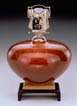
The field of Wood turning has matured apace over the past ii decades, achieving an heady level of quality, artistic expression and technical innovation. (left: William and Marianne Hunter, Untitles #1874, Vessel: pinkish ivorywood, lathe-turned; Stand up: constructed; Lid: Wisteria Kimono, Edo Period, 1991. Enamel in 24 karat gold, 14 karat golden, sterling silver, bizarre pearls, opal, druzy lavander chalcedony, 9 1/4 x 6 x 6 inches)
Turning Woods into Art: The Jane and Arthur Mason Collection on display at Charlotte's Mint Museum of Craft + Pattern May twenty through October eight, 2000 showcases 125 objects, from bowls and vessels to abstract sculptural works, from one of the world's foremost collections of contemporary lathe-turned wood. Included are works of unsurpassed richness and diverseness from 43 North American and European masters of the craft, among them David Ellsworth, Mark and Mel Lindquist, Ed and Philip Moulthrop, Ron Kent, Virginia Dotson, Rude Osolnik, Bob Stocksdale and Todd Hoyer.
 The objects on brandish range from James Prestini's Mexican Mahogany Bowl epitomizing the classic ideals of extreme simplicity, beautifully grained patterns, thin and taut walls, and perfect proportion so valued by first-generation turners, to the spontaneous sequences of pattern, shape, texture and surface handling, created past chainsaw, in Mark Lindquist' s sculpture Amalgam II. Accompanying the exhibition is a major publication past Harry Northward. Abrams Press of New York with feature essays by Suzanne Ramljak, Curator of Exhibitions at the American Federation of Arts, and Michael Monroe, formerly executive managing director of the American Crafts Quango. (left: Bud Latven, Triangles series #1, 1990, Macassar ebony, blackness ebony, tulipwood, veneers, segment-constructed, lathe-turned, vi x 4 10 4 inches)
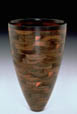
The popularity of Wood turning has undergone sharp ascents and declines throughout history, according  to Ramljak. During the 16th and 17th centuries, lathe-turning was almost an obligatory activity within European courts. Keiser Rudolph II (1552-1612) and Czar Peter the Corking (1672-1725) good turning wood as a form of recreation and from the prevailing conventionalities that God was a turner equally the globe and planets were perfect spheres whose concentric forms could only accept been crafted on a lathe. At its artistic low ebb, Woods turning was regarded as the domain of the hobbyist in the garage. The recent surge in popularity has wood-turned objects poised to regain a key role within contemporary society as evidenced by their widespread inclusion in museum exhibitions and collections in the 1990s. (right: Ron Kent, Pocket-sized Golden Translucent Bowl, 1989, Norfolk Isle pine, lathe-turned, 5 1/ii 10 8 x viii inches)
Arthur and Jane Mason of Washington, D.C. accept nerveless over 600 wood-turned objects since being 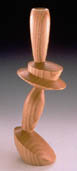 inspired by a 1986 exhibition of turned woods bowls from the Edward Jacobson Drove (now housed at Arizona State University) at the Smithsonian Institution' s Renwick Gallery of American Craft. The Masons take contributed pieces to the Renwick Gallery, the Detroit Institute of Fine art, the American Craft Museum and the Art Institute of Chicago, among other institutions. They were persuaded by wood turner Marker Lindquist, after his initial visit, to keep their vision together, donate to one museum, and publish the history of the collection. (correct: Marking Sfirri, Multiaxis Candlestick #one, 1992, Ash, multi-axis lathe-turned, 4 x 4 x four inches)
"When Marking Leach called us in 1996 to tell us that NationsBank (at present Bank of America) was supporting a new Mint Museum of Arts and crafts +Design in downtown Charlotte, and that he would become manager, nosotros knew that our collection should go to North Carolina," said Jane Mason. Leach and the Masons selected 126 works representative of the latitude of the collection to exist donated to the new museum.
"At the cadre of our vision is the reawakening, the Renaissance of Wood turning as an art," stated Arthur Mason. "Our drove grew from the burst of creativity when the early on artists - James Prestini, Bob Stocksdale, Rude Osolnik, Ed Moulthrop, Mel Lindquist and Dale Nish, each alone in his studio developing his way, beginning met and inspired each other in the 1960s. It includes the side by side major group of turners to emerge - David Ellsworth, Mark Lindquist, Hap Sakwa and others from the Jacobson Collection."
 Essayist Suzanne Ramljak writes that the exceptional quality and scope of the Arthur and Jane Bricklayer Collection allows for a sustained assay of a total range of traits, virtues and issues that define the turned-woods object. Part of woodturning's dubious reputation among the craft globe'southward long-standing worship of the handmade is the peculiar alloy of the organic and the industrial. When woods is mounted on a lathe, nature becomes field of study to the forces of industry. The hybrid event lends turned-wood objects much of their interest and fifty-fifty poignancy. (left: Todd Hoyer, Conical Series, 1986, Emery oak, lathe-turned, 7 one/iv x 12 x 10 1/2 inches)
Interestingly, avoiding perfection may be the biggest claiming that turners face up since the lathe allows for the cosmos of precisely symmetrical and finished forms. While imperfection in an object imparts a sense of life, mathematical precision often produces sterility.
Some turners chose to efface all traces of the natural material through lacquer, paint or elaborate etching, while others limit their manipulation of the material, assuasive the wood to remain equally raw as possible. The majority of turners are drawn to the medium precisely because woods is such an irregular fabric and lends an exciting unpredictability to the creative process.
"The shape of a log, the grain pattern, cracks, faults or rotten spots all play a part in my discovery of new shapes," remarked Bob Stocksdale.
While turned-wood objects are linked to the primal natural world, they also participate in the more progressive features of advanced culture, namely chance methods and establish objects. The creative process involves every bit much finding and selecting equally it does making and constructing. While turners manipulate the forest forms that they find pre-existing in nature, or make slight modifications as in Melvin Lindquist's Tiptop Bowl (1985) or Mark Lindquist's Chieftain's Basin (1988), they do not construct or sculpt their works in the traditional sense.
"Unlike clay, glass, metals and fiber, where the material is shifted and rearranged to the creative person'due south desire, my works have always been at that place," remarked Ed Moulthrop. "The forest you see is the forest exactly equally it was created. I only uncover it and there it is!" Michael Peterson adds, "While harvesting and collecting buried wood, I detect and explore the physical cloth - a process that yields all the excitement and free energy institute in a treasure chase or like that in unearthing artifacts from an ancient culture."
Some other essential aspect of Woods turning is the use of chance or uncontrolled effects in the artistic process. Free-style turning, an arroyo pioneered past artists like David Ellsworth, incorporates defects in the wood such as splits, rotten areas and bark inclusions to produce uniquely irregular forms. In the chance-filled technique of green turning, uncured wood is turned on the lathe and allowed to dry after turning. As the slice slowly cures the wood begins to compress and assume surprising shapes beyond the pale of the turner.
"The procedure produces an asymmetrical form that allows the life force of the tree to have the terminal word, thus freeing me from full control over the concluding course," stated Todd Hoyer.
Essayist Michael Monroe notes that a wood turner has little assurance of predictability, purity and uniformity from the material. Having been predetermined by natural process beyond his or her control - soil status, drought, disease, lightening and fire - the turner's dialogue is dually complex. Act and react. Every bit turner Virginia Dotson expresses the process, "We dream of perfect harmonies...take a chance intervenes."
Today'due south turners are more likely to consider using the lathe as simply the first footstep of several toward a desired stop. Some gimmicky turners juxtapose woods with other materials, such equally golden, sterling argent, baroque pearls, cloisonné enamel and semi-precious stones (even spinous wire!). Other innovations include the awarding of industrial chemicals such as plastic resins and epoxies; the apply of industrial power tools such as chain saws, sandblasters and flexible drill shafts; the technique of segmenting and laminating forest to achieve precision surface decorations; and the introduction of multi-axis turning techniques.
On the issue of the not-utilitarian nature of most turned-forest vessels, Mark Lindquist' s remarks on a spalted bowl sufficiently summarizes the thoughts of virtually wood turners. "Its office is to display the dazzler of nature and to reflect the harmony of human being. Information technology is wrong to ask the spalted bowl to function every bit a workhorse as well, to concur potato chips, or salad or to store trivialities. The bowl is already full. Information technology contains itself and the space between the walls." Like other abstract fine art, turned-wood forms primarily serve as objects for meditation or arousal, and their foremost impact is on the sensual level.
"Electronic or digital media - television, video, computers, virtual reality - bring with them dematerialized and disembodied relations, replacing direct physical contact with mediated virtual contact," wrote Ramljak. "The sense of wholeness that organic forms impart thus becomes more necessary today as a source of physical and psychic sustenance."
Read more Resource Library Magazine articles on Mint Museum of Art / Mint Museum of Arts and crafts+Design
Please click on thumbnail images bordered past a cerise line to see enlargements.
rev. i/15/11
Search Resources Library for thousands of articles and essays on American art.
Copyright 2011 Traditional Fine Arts Organization, Inc. , an Arizona nonprofit corporation. All rights reserved.
Source: https://tfaoi.org/aa/1aa/1aa466.htm
0 Response to "Turning Wood Into Art the Jane and Arthur Mason Collection"
Post a Comment