Dividend Policy a Review of Theories and Empirical Evidence
1. Introduction
A dividend is a distribution of profits by a corporation to its shareholders. When a corporation earns a profit or surplus, it is able to pay a proportion of the turn a profit as a dividend to shareholders. The remaining profit later on dividend, namely retained earnings will exist used to re-invest in the future.
A high dividend payment means that the company is reinvesting less money back into its business organisation. According to Khan et al. (2019) companies with high dividend tend to attract investors who adopt the assurance of a steady stream of income to a high potential for growth in the share price. On the contrary, companies with low dividend payment means that the companies is reinvesting in business concern growth, so that the higher future capital letter gains for investors.
Studies on the impact of the dividend policy on the fiscal performance of enterprises have been carried out by many scholars effectually the world. Some scholars believed that this topic is one of the nigh challenging research issues (Onanjiri and Korankye 2014; Frankfurter and Wood 2002; Amidu 2007). Some others recollect that dividend policy is not only business concern transaction, only it is business firm'southward strategy applied to distribute income to shareholders (for instance, Gill et al. 2010).
Regardless of diverse enquiry, the previous studies have evidenced the differences about the impact of dividend policy on a business firm'southward financial performance. Some scholars believed that dividend policy significantly and positively impact on fiscal performance (for instance, Ali et al. 2015). Some others reported that dividend policy bear on significantly but negatively to firm performance (Onanjiri and Korankye 2014). The differences in research outcome are not only betwixt research years but also inconsistent across countries (Glen et al. 1995; Kim and Kim 2020), and fifty-fifty among economical sectors in a specific country (Khan et al. 2019).
This paper is motivated past occurrence of different research results. It aims to find the effects of dividend policy (represented by dividend rate and decision of dividend payment) on firm's fiscal performance. Findings from this could contribute to literature by confirming the previous research. Moreover, it could aid firms' managers in setting dividend policies for listed firms through which could control their cashflow and financial performance.
The newspaper has the following parts: the next section is the analysis of the literature review and theoretical framework, followed by the research methodology, empirical findings, discussions and recommendations, and concluding remarks.
2. Literature Review and Theoretical Framework
Firms' management always concerns virtually whether to pay dividends to shareholders or to retain them for future re-investments and what percent should be practical if dividend payments are made. The firms' managers need to align shareholders, insiders, and outsiders with each other.
The theoretical principle underlying the effect of dividend policy on a house's operation can be described in dividend relevance theory stated by Miller and Modigliani (1961). They theorized that dividend policy has no impact on stock price and cost of uppercase, resultantly the dividend policy of a firm is irrelevant for shareholders' wealth in keeping with perfect majuscule market place assumptions. Miller and Modigliani (1961) revealed a well-designed analysis of the relationship between dividend policy, growth, and share valuation. Based on well-divers but a simplified prepare of perfect capital letter marketplace assumptions, Miller and Modigliani (1961) expressed a dividend irrelevance theorem. Co-ordinate to this concept, investors exercise non pay whatever importance to the dividend history of a company and thus, dividends are irrelevant in calculating the valuation of a company. Due to the distribution of dividends, the toll of the stock decreases and will nullify the proceeds fabricated by the investors because of the dividends.
Litzenberger and Ramaswamy (1982) showed that dividend policy influences investor behaviors as a result of disparity in tax on dividends and upper-case letter gains. The authors believed that investors adopt low-dividend businesses since the amount of taxes payable is minimized. Jensen and Meckling (1976) stated that there is a tradeoff in the form of agency costs between having more than or less insider ownership. Agency costs are created whenever the managing director also controls an outsider'due south investment besides her own, because there is a fundamental conflict of involvement.
The side by side underlying theory is the pecking order theory which was first introduced by Donaldson (1961) and modified by Myers and Majluf (1984). The Pecking Lodge Theory relates to a visitor's capital structure. The theory states that managers follow a hierarchy when considering sources of financing. The pecking guild theory arises from the concept of asymmetric data which causes an imbalance in transaction ability. Company managers typically possess more data regarding the company's performance, prospects, risks, and future outlook than external users such as creditors (debt holders) and investors (shareholders). Therefore, to compensate for data asymmetry, external information users demand a college render to counter the adventure that they are taking. Equally opposed to external financing, internal financing is the cheapest and most user-friendly source of financing.
Another underlying theory for dividend policies is the signaling theory that was firstly introduced by Spence (1973) and it is useful for describing behavior when 2 parties (individuals or organizations) have access to different information sources as sender or receiver and both parties act differently. Dividend signaling is a theory that suggests that visitor announcements of dividend increases are an indication of positive future results. Increases in a company's dividend payout generally forecast a positive future functioning of the company's stock. In the finance area, the reporting principle shows that the shift in dividends will requite shareholders an indication of the hereafter profitability of the business and perceptions of management. Direction volition non increase dividends unless it is sure that future earnings volition meet the dividend increase. The refuse in dividend payout is considered a negative signal because investors will think that the company'due south hereafter earnings are going to subtract (Miller 1980).
Amidu (2007) examined whether dividend policy influences firm performance in Ghana. The analyses are performed using information derived from the fiscal statements of listed firms on the Ghana Stock Commutation (GSE) during the recent viii-year period. The results showed positive relationships between render on avails, dividend policy, and growth in sales. Surprisingly, the study reveals that bigger firms on the GSE perform less with respect to render on assets. The results too revealed negative associations betwixt return on avails and dividend payout ratio. The results of the study generally supported previous empirical studies (see, for case, Michaely and Allen 2002; Gordon 1963; Bhattacharya 1979; Shefrin and Statman 1984; Easterbrook 1984; Amidu and Abor 2006; Danila et al. 2020).
Murekefu and Ouma (2012) sought to establish the relationship between dividend policy with dividend payout every bit representative variable and firm performance among listed firms in the Nairobi Securities Exchange. The findings indicated that dividend payout was a major gene significantly positive affecting firm performance. It tin can be concluded, that dividend policy is relevant and that managers should devote adequate fourth dimension in designing a dividend policy that will enhance firm functioning and therefore shareholder value.
Besides using dividend payout variable, Onanjiri and Korankye (2014) ascertained the impact of dividend policy on the financial performance of manufacturing firms that are trading on the Ghana Stock Commutation. The regression results reveal that dividend payout significantly negative impacts firms' fiscal performance. For the control variables, size and leverage were inversely related to performance while sales growth positively correlated with performance. Except for size, all the command variables were found to exist statistically significant. Intuitively, quoted manufacturing firms in Ghana which are interested in accentuating their return on assets may have to rationalize the quantum of dividend payout. This will help them accrue loftier retained earnings to buttress investment in positive net present value projects which will fuel sales growth and thereby lessen their dependence on expensive debt finance in Ghana.
With the aforementioned vein of research, Velnampy et al. (2014) attempted to find out the relationship betwixt dividend policy and business firm performance of listed manufacturing companies in Sri Lanka. A set of listed manufacturing companies was investigated. Returns on disinterestedness and return on assets were used equally the determinants of firm performance whereas dividend payout and earnings per share were used as the measures of dividend policy. The study found that determinants of dividend policy are not correlated to the firm performance measures of the system.
Using dividend payment as contained variable for the model testing the influence of dividend on financial performance of 172 firms in Istanbul Stock Exchange, Dogan and Topal (2014) showed that dividend payments had influence on companies' performances, only in dissimilar ways for accounting-based indicators (ROA, ROE) and for market-based i (Tobin's Q).
Vijayakumaran and Atchyuthan (2017) empirically examined the relationship betwixt greenbacks holdings and corporate performance using a sample of firms listed on the Colombo Stock Exchange over the period 2011–2015. Controlling for unobserved heterogeneity and other business firm characteristics, this study constitute that cash holdings are positively related to business firm operation. Ali et al. (2015) attempted to find out the touch of dividend policy on firm performance nether high or low debt for all the non-financial sector companies listed on the Karachi Stock Exchange. They utilized the secondary information published by the State Bank of Pakistan in the shape of balance canvas analysis of the non-financial sector from 2006 to 2011 with the sample size consisting of 122 companies. They mainly focused on using two operation measures i.e., Tobin's Q and Return on Disinterestedness both as dependent variables while the control variable includes the business firm size and growth with debt as the moderating variable. They plant that the dividend payout ratio has a significant positive human relationship with Tobin'due south Q and ROA when there is both less and high debt. Also, in that location is no moderating effect of debt on the human relationship betwixt dividend payout ratio and firm performance of all the non-fiscal firms listed on the KSE.
Khan et al. (2016) conducted a similar study for some firms listed on the Pakistan Stock Substitution from 2010 to 2015. The OLS technique was applied and the research results evidence that in that location is a positive relation betwixt return on assets, dividend policy, and auction growth. The results of the research are more often than not similar to those of Ali et al. (2015). Specifically, the results testify that the dividend payout ratio and leverage accept a significant negative relation with the return on equity.
Chiliad'rabet and Boujjat (2016) sought to examine the relationship between dividend policies and financial performance of selected listed firms in Morocco. 2 models were developed in an try to provide a theoretical explanation on the birds-in-manus dividend relevance theory and the Miller and Modigliani'southward (1961) dividend irrelevance theory. The findings indicated that dividend policy is an important gene affecting firm performance. Their relationship was also significantly positive. This, therefore, showed that dividend policy was relevant. It can be concluded, based on the findings of this research that dividend policy is relevant and that managers should devote adequate time in designing a dividend policy that will enhance firm operation and therefore shareholder value.
In Vietnam, the dividend payment of many companies listed on the stock market, without any strategic credits, is still spontaneous. Regarding dividend payment, businesses would have different ways of dividend payout at different times. Businesses pay dividends more than frequently with higher payout ratios in certain industries when the business operation is profitable. Proponents of dividends betoken out that a high dividend payout is important for investors because dividends provide certainty virtually the visitor's financial well-being. Still, the dividend may non be paid, fifty-fifty though businesses are profitable. If a company thinks that its own growth opportunities are better past available investment opportunities elsewhere, it often keeps the profits and reinvests them into the business. When a company decides not to offer a dividend payment, it keeps more than coin for its own operations. Instead of rewarding investors with a payment, it can invest in its operations or fund expansion in hopes of rewarding investors with more valuable shares of a stronger company. Research on this outcome has been conducted, but the results are more often than not applicable to manufacturing companies (Tran et al. 2015).
In Vietnam circumstance, at that place take been few studies about the relationship between dividend policy and a house's operation that report similar results. Tran et al. (2015) practical the previously accepted model with ROE, ROA, and Tobin'due south Q are dependent variables, and dividend payout ratio and decision of dividend payment (binary value) are independent variables. The information was collected from audited fiscal statements of listed firms from 2009–2013. The writer study that the cash dividend payment has a meaning touch on the house'due south performance measured. However, the dividend payout ratio has negative impact on firms' fiscal performance. This enquiry contributes significantly to literature, nonetheless, this study contained some drawbacks, such as (1) collected data during the financial distress period of Vietnam; (2) small sample size; and (3) data for computing yearly dividend payout is not always provided so that the contained variable is not truly reliable.
From the higher up, we can run across that the impact of dividend policy on a firm'due south operation has been investigated by many scholars from both developed countries and developing countries. And the results are not consistent. Some authors believe that dividend affects a firm's functioning significantly and positively, while others show the reversed results, and some scholars indicate that there is no relationship betwixt these ii factors.
From theories and literature review at that place are two research hypotheses proposed as following:
Hypotheses1(H1).
Dividend rate has negative impact on firms' fiscal operation.
Hypothesesii(H2).
Decision of dividend payment has positive impact on firms' financial performance.
3. Research Methodology
3.ane. Research Model
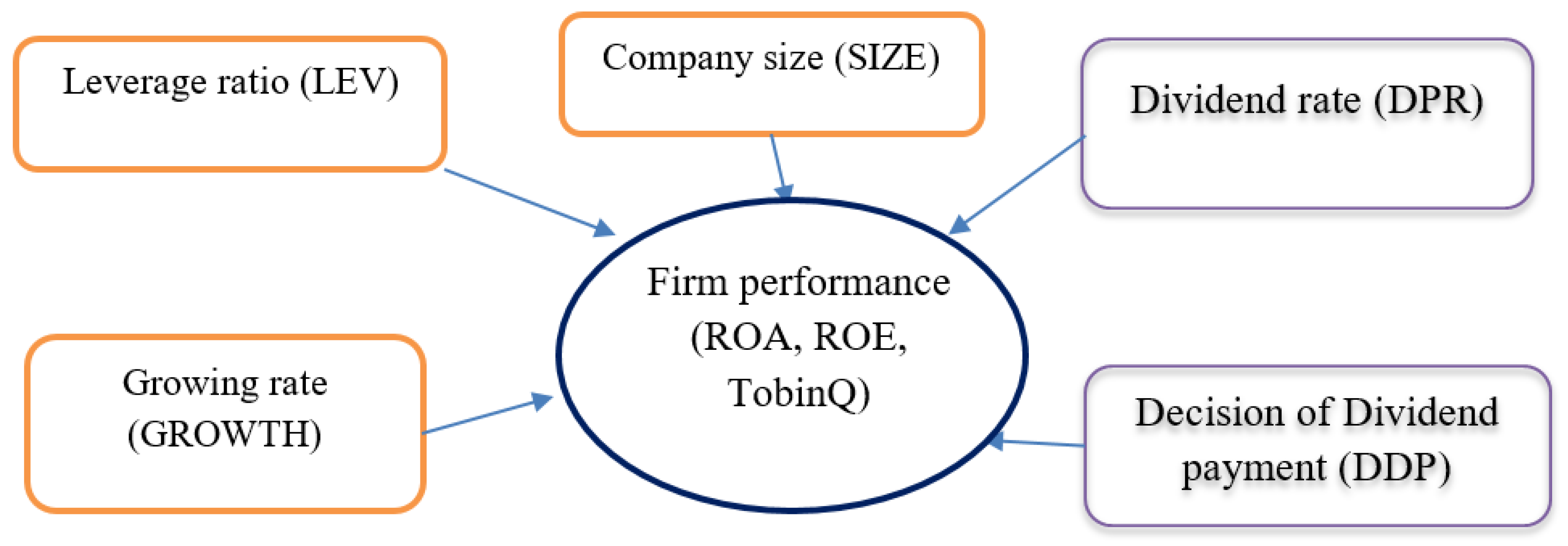
From the literature review of previous research models, we plant that almost of the studies accept measured the impact of dividend policy on the business firm'south financial performance. The following research model (Figure one) is built on Tobin's Q, ROA, and ROE equally a measurement of the firms' fiscal performance and five variables as contained variables. This measure is consistent with the studies of previous scholars such as Amidu (2007), Murekefu and Ouma (2012), and Velnampy et al. (2014), Dogan and Topal (2014), Tran et al. (2015), and Khan et al. (2016).
From the general model, we decomposed it into iii separate models for each dependent variable, every bit follow:
- (1)
-
ROAit = β0 + βiDPRit + βiiDDPit + β3SIZEinformation technology + β4LEVit + β5GROWTHit + εinformation technology
- (two)
-
ROEit = β0 + βaneDPRinformation technology + β2DDPit + β3SIZEinformation technology + β4LEVit + β5GROWTHinformation technology + εinformation technology
- (three)
-
TOBIN'SQinformation technology = β0 + β1DPRinformation technology + β2DDPit + β3SIZEit + βfourLEVit + βvGROWTHit + εit
where:
-
ROAit: Render on average total assets of the visitor i menstruum t
-
ROEinformation technology: Render on boilerplate equity of company i period t.
-
TOBIN'South Qit: is a measure of firm assets in relation to a firm'south market value (the company i, catamenia t). The formula for Tobin'due south Q is: Tobin'due south Q = Total Market place Value of House/Total Book Value of Firm
-
DPRit: dividend rate (pct) of the company i menstruation t. DPR measured by the amount of dividend on par value of share.
-
DDPit: Decision of dividend payment of the company i period t. It takes value of ane if firm pays dividend, otherwise it gets nil.
-
SIZEit: Logarithm of full assets of the company i menstruation t.
-
LEVit: Financial leverage of visitor i period t.
-
GROWTHit: Growth of revenue of company i menstruation t.
3.two. Information Source and Information Collection
As mentioned in a higher place, the objective of the inquiry is to investigate the issue of dividend policy (measured by dividend rate, decision of dividend payment) on the firm'south performance (ROA, ROE, and Tobin'due south Q are representative). Thus, we collect financial statements of firms listed on the stock market of Vietnam. We believe that this information source is highly credible because, under Vietnamese law, all list firms are required to submit audited financial statements. And to overcome the drawback of the previous study, we choose a longer time frame—from 2008 to 2019.
Up to the finish of 2019, there are 745 firms listed on Vietnam's official stock exchange. All firms' financial statements from 2008 to 2019 are downloaded. After that, the information is arranged into a multi-cavalcade excel file and then ratios for variables for each company in research sample are calculated.
Having estimated the ratios, nosotros check the data and found out that several companies did non disclose the dividend rate and/or conclusion of dividend payment. Besides, some of the listed companies have a information bridge of less than 12 years. These companies are removed from the inquiry sample. At the end, only 450 eligible firms to exist selected for the inquiry study.
According to Tabachnick and Fidell (1996), the sample size should be due north = fifty + 8*thou (where chiliad is the number of variables). Based on this, it is believed that the inquiry sample is satisfied for running a statistical test or regression and enquiry results may be practical to the whole population.
iii.3. Data Processing Method
Due to the use of pooled data, we have to apply the appropriate method of processing the information. Diverse statistical and econometric methods and techniques are applied footstep-past-step, as follows:
Get-go, information descriptions by min, max, median, mode, and standard deviation. This will provide some general features of the firms such equally size, growth, leverage, greenbacks dividend per share, the proportion of earnings for the dividend. The statistical description also reports the variance between firms relating to each variable in the research model.
Second, a correlation test is conducted to cheque the relationship between independent variables and dependent variables. If two contained variables are strongly correlated, reflecting a reasonably perfect value of correlation coefficient (around 1.0), the research model may have a multicollinearity trouble, in which case i contained variable must exist removed. Similarly, if the correlation coefficient between contained variables and the dependent variable is naught, this ways that there is no correlation between them. As a result, that independent variable is not suitable for the research model.
Third, multicollinearity problem is tested. Multicollinearity exists whenever an contained variable is highly correlated with i or more than of the other independent variables in a multiple regression equation. Multicollinearity is a problem because information technology undermines the statistical significance of an contained variable. It is advised that the VIF predictor should be calculated. If VIF is greater than 5, it ways multicollinearity problem exists (Hoang and Chu 2013).
Fourth, the F-examination is used to choose the best fit model among OLS and FEM. If FEM is called, the Hausman test is conducted to choose between FEM or REM.
Finally, beta for independent variables in the model is tested. By doing this, the variables which take the greatest effect on firms' performance could be found and whether the influence is positive or negative at a specific statistical significance level. The results of the tests are presented in the following section.
4. Empirical Findings
The statistical description in Table 1 indicates that the sample firms take an average ROE of 14 per cent, average ROA of effectually 7 per cent, and average Tobin's Q is only 0.61—the market value of listing firms is lower than to their book value. The low Tobin's Q implies the pessimistic about the firms' future development.
For the dividend variables, the results indicate that there are more than 60 per cent of sample firms paid dividend to shareholders (measured by DDP). However, the average dividend rate for the sample firms is quite depression, around 10.five per cent.
The second examination conducted is the correlation betwixt variables and the effect is reported in Table ii, as follows.
The results from Table 2 prove that the dividend policy variables (measured by DPR and DDP), have a positive relationship to the firms' operation measured by ROA, ROE, and Tobin Q. Conversely, leverage and firm size (measured past logarithms of assets) take a negative correlation to firms' performance. The report results also testify that the contained and dependent variables are correlated with each other, satisfying correlation conditions, and no variable is removed from the research model.
We also bank check for multicollinearity problems using the VIF indicator. The results reporting in Table three show that the VIF is smaller than 2, significant in that location no multicollinearity issues in our enquiry model (Hoang and Chu 2013).
Autocorrelation is also tested past using Wooldridge exam in panel data. The exam outcome is
F(1, 449) = 2.149; Prob > F = 0.1434
This examination result implies that in that location is no serial autocorrelation in the model.
Later on checking for correlation, autocorrelation, and multicollinearity bug, we proceed evaluating the appropriateness of the regression model for panel information. To do this, nosotros first conduct the Pooled OLS and Fixed outcome model (FEM). The results from F-exam testify that FEM is more than advisable than OLS. This leads to the test existence performed to compare betwixt FEM and Random effect model (REM) by using the Hausman test, and we constitute that the FEM is more advisable and called. The regression results are presented in the post-obit Table 4.
The research model for ROA could exist presented as the following equation:
ROAi,t = 0.346 + 0.0008DPR − 0.0085DDP − 0.0080SIZE − 0.0014LEV + 0.0002GROWTH + εit
Showtime, the dividend rate (DPR) had a positive upshot on ROA, statistically meaning at 1% level. This result indicates that a higher charge per unit of dividend leads to a higher return on total avails, but the influence level is very modest. When the dividend rate increases by one percentage, the ROA increases merely 0.0008 percent. This issue is like to the written report by Amidu (2007) but in contrast to the study by Khan et al. (2016), who evidenced that dividend rate is negatively correlated to ROA. This phenomenon may be explained by the fact that when companies increase dividend, they can mobilize more capital for further development, and, as a upshot, the profitability decreases.
2d, decision of dividend payment (DDP) has negative effect on ROA, at statistical level of 1%. It implies that the proclamation of dividend affects to firm'southward performance in negative fashion.
Third, with regard to the controlling variables, both firms' nugget size (SIZE) and leverage (LEV) take a statistically negative result on ROA. Nevertheless, the firms' sale growth (GROWTH) had a significantly positive impact on ROA.
Fourth, the regression results as well bear witness that the value of R-square = 0.2217, which means that the independent variables of the model explained 22.17% of the change of the dependent variable.
The research model for ROE could be presented as the following equation:
ROEi,t = 1.001 + 0.0015 * DPR − 0.0183 * DDP + 0.0004 * GROWTH − 0.0323 * SIZE + 0.0001 * LEV + ε
Showtime, similarly as ROA, the DPR variable has a positive impact on ROE at a significance level of 1% and the influence level is too pocket-size. Specifically, the increase of DPR by ane% leads to an increment of ROE by 0.010%.
Second, DDP has a negative bear on on ROE at statistically significant level of 1%. Every bit same as ROA, firms' declaration of dividend impact reversely to firms' financial performance.
3rd, for controlling variables, the result shows that only sale growth and firm size have statistically significant impact on ROE in different ways, sale growth leads to college performance but firm size results in lower performance. Surprisingly, the firms' leverage does not take significant affect to ROE.
Fourth, the regression results also prove the value of R-square = 0.0574, which indicates that the independent variables of the model explain but 5.74% of the change of the dependent variable. There are many other factors affecting to return on equity.
For the Tobin's Q, the inquiry model could be presented equally the post-obit equation:
TOBIN'SQi,t = 3.704 − 0.0021 * DPR + 0.0189 * DDP − 0.0001 * GROWTH − 0.0985 * SIZE − 0.0082 * LEV + ε
The research results point that:
Kickoff, DPR negatively impacts Tobin'south Q a statistically significance level of one% with minor magnitude. It ways that if the dividend rate increases by 1 pct, Tobin'southward Q will decrease by 0.0021 percentage bespeak. The decision of dividend payment (DDP) also contributes to the increase of Tobin'southward Q, at a significant level of x%.
For controlling variables, financial leverage, sales growth and size have negative bear upon on Tobin's Q and they are all statistically significant.
For the cribbing of the model, the regression results too bear witness that the value of R-foursquare = 0.1364 which shows that the independent variables of the model could explicate 13.52% of the change in Tobin's Q.
From the results of the to a higher place three models, we could realize that both in book value and market value, the dividend rate (DPR) has an inverse impact on firms' financial operation, meanwhile the decision of dividend payment (DDP) has various furnishings on firm'southward performance.
5. Conclusions and Recommendations
Based on the results of the research above, it can be seen that the Vietnamese firms offer quite low dividend rate, an average amount of 10 per cent. This low dividend rate, in i manus, prove that firms are retaining turn a profit for operation and future investment. As a upshot, some shareholders believe on future prospect so that they continue investing their money into the firms. However, the depression dividend, on the other hand leads to the decrease of marketplace expectation to the firms' time to come development.
The high deviation value (xvi.iii%), the broad variance range of dividend rate (0 to 214 per cent) may reflect the lack of systematic and reasonable dividend policy in Vietnamese listed firms. Firms may subjectively offer a high dividend rate or loftier cash dividend for the year in which they want to mobilize capital letter without taking into consideration the effect of such policies on the firms' financial operation, either the accounting-based value or market-based value.
Based on the research results, the newspaper proposes the following instructive suggestions:
Start, firms should choose and employ the economic model for dividend policies, including dividend charge per unit, conclusion of dividend payment. Model of dividend policy should be stable, long-term, strategic, and not exist affected past immediate influence of firms' managers. By doing that, the firms may control the cashflow and the required capital structure to achieve the best financial performance.
Second, firms' dividend policies should embed investment policy and financing policy for each stage in firm life bicycle. For example, in introduction and growth stages, firms should have low dividend charge per unit but in the maturity period, where high profit and cash available, the dividend should exist high.
Third, it is evidenced that dividend policy too depend on diverse factors. Therefore, firms should take into account the factors similar country characteristic, development period, and on bureau toll of debt. These suggestions have been evidenced by several scholars (for example, Brockman and Unlu 2009) or country culture (Zheng and Ashraf 2014).
Fouth, firms demand to realize that the conclusion of dividend payment (DDP) has a negative impact on firms' fiscal performance, and dividend rate bear on positively to firms' performance. Thus, firms should construct progressive strategy of dividend payout rate, with i steady rate and some additional payments for special circumstances.
And last but not least, firms should clearly communicate to shareholders near the tradeoff betwixt loftier dividend payout rate and performance, so that shareholders volition willingly accept the depression dividend rate, retaining profit as capital for future development.
Inquiry on the impact of dividend policies on the fiscal functioning of Vietnamese listed enterprises evidence that the dividend charge per unit and decision of dividend payment have an event on firms' financial functioning, measured by ROA, ROE, and Tobin's Q in different ways. Based on the findings, we also advise some instructive recommendations for firms, including a more appropriate model of dividend policies, keeping depression dividend charge per unit, and clear proclamation of dividend payment. These might exist useful for listed firms, regulators, investors, and others in making investment decisions for firms.
Nevertheless, the enquiry model may still contain some limitations. Ane of this is related to low R-square in the model. It means that the paper may have not uncovered many other factors related to dividend policies that straight or indirectly touch on the firm'due south performance. In add-on, the newspaper has not taken into account the effect of time, industry, firm's age, etc. We believe that those potential drawbacks may exist the gap for further research in the hereafter.
Author Contributions
Conceptualization: C.D.P., A.H.N. Methodology: C.D.P. Software: T.5.T. Validation: H.T.Northward. Formal Analysis: T.T.T. Investigation: T.V.T. Information curation: Due north.T.D., T.T.T. Writing original draft training: T.T.T. Writing, Review and Editing: C.D.P. Supervision: C.D.P. Terminal Acquisition: A.H.N., H.T.N. All authors take read and agreed to the published version of the manuscript.
Funding
This inquiry received no external funding.
Institutional Review Board Argument
The study was conducted according to the guidelines of the Declaration of Helsinki, and approved by the Institutional Review Board.
Informed Consent Statement
Informed consent was obtained from all subjects involved in the study.
Data Availability Statement
Data used for this study is collected from audited financial statements of Vietnamese firms which are listing in the stock market place of Vietnam.
Acknowledgments
This research is funded by the National Economic science University (NEU), Vietnam. The authors thank anonymous reviewers for their contributions and the NEU for supporting this research.
Conflicts of Involvement
The authors declare no disharmonize of interest.
References
- Ali, Adnan, Farzand Ali Jan, and Maryam Atta. 2015. The impact of dividend policy on firm performance under loftier or low leverage: Evidence from Islamic republic of pakistan. Journal of Direction Information 2: xvi–24. [Google Scholar] [CrossRef]
- Amidu, Mohammed. 2007. How does dividend policy affect the functioning of the firm on the Ghana Stock Exchange? Investment Management and Financial Innovations 4: 103–12. [Google Scholar]
- Amidu, Mohammed, and Joshua Abor. 2006. Determinants of dividend payout ratios in Republic of ghana. The Journal of Run a risk Finance seven: 136–45. [Google Scholar] [CrossRef]
- Bhattacharya, Sudipto. 1979. Imperfect information, dividend policy, and the bird in the hand fallacy. The Bell Periodical of Economics ten: 259–lxx. [Google Scholar] [CrossRef]
- Brockman, Paul, and Emre Unlu. 2009. Dividend policy, creditor rights, and the agency costs of debt. Journal of Financial Economic science 92: 276–99. [Google Scholar] [CrossRef]
- Danila, Nevi, Noor Azizan, and Zaheer Ahmez. 2020. Growth opportunities, capital construction and dividend policy in an emerging market: Indonesia case study. The Journal of Asian Finance, Economics, and Business organization seven: 1–viii. [Google Scholar] [CrossRef]
- Dogan, Mesut, and Yusuf Topal. 2014. The Influence of Dividend Payments on Company Performance: The Case of Istanbul Stock Exchange (BIST). European Journal of Business and Management 6: 189–97. [Google Scholar]
- Donaldson, Gordon. 1961. Corporate Debt Capacity: A Study of Corporate Debt Policy and the Determination of Corporate Debt Capacity. Boston: Partitioning of Inquiry, Graduate School of Business concern Assistants, Harvard Academy. [Google Scholar]
- Easterbrook, Frank H. 1984. Two agency-price explanations of dividends. The American Economic Review 74: 650–59. [Google Scholar] [CrossRef]
- Frankfurter, George M., and Bob Thousand. Woods. 2002. Dividend policy theories and their empirical test. International Review of Financial Analysis 11: 111–38. [Google Scholar] [CrossRef]
- Gill, Amarjit, Nahum Biger, and Rajendra Tibrewala. 2010. Determinants of Dividend Payout Ratios: Evidence from Usa. The Open up Business Periodical 3: 8–14. [Google Scholar] [CrossRef]
- Glen, Jack D., Yannis Karmokolias, Robert Miller, and Sanjay Shah. 1995. Dividend Policy and Beliefs in Emerging Markets: To Pay or Not to Pay. International Finance Corporation Give-and-take Paper. No. IFD 26*IFC Working Paper Serial; Washington, DC: World Depository financial institution Group, Available online: http://documents.worldbank.org/curated/en/325441468741588836/Dividend-policy-and-behavior-in-emerging-markets-to-pay-or-not-to-pay (accessed on 30 March 2021).
- Gordon, Myron J. 1963. Optimal investment and financing policy. The Journal of Finance 18: 264–72. [Google Scholar] [CrossRef]
- Hoang, T., and N. M. Due north. Chu. 2013. Applied Statistics in Socio-Economic Research. Hanoi: Statistical Publisher. [Google Scholar]
- Jensen, Michael C., and William H. Meckling. 1976. Theory of the firm: Managerial beliefs, bureau costs, and buying construction. The Periodical of Financial Economics 3: 305–60. [Google Scholar] [CrossRef]
- Khan, Mula Nazar, Babar Nadeem, Fahad Islam, Muhammad Salman, and Hafiz Muhammad Ikram Sarwar Gill. 2016. Touch on of dividend policy on firm performance: An Empirical Evidence From Pakistan Stock Exchange. American Journal of Economics, Finance and Management 2: sixteen–25. [Google Scholar]
- Khan, Kamran, Houda Chakir Lamrani, and Shah Khalid. 2019. The impact of dividend policy on firm performance: A case written report of the industrial sector. Risk Governance & Control: Financial Markets & Institutions ix: 23–31. [Google Scholar] [CrossRef]
- Kim, Taekyu, and Injoong Kim. 2020. The influence of credit scores on dividend policy: Show from the Korean market. The Periodical of Asian Finance, Economics, and Business 7: 33–42. [Google Scholar] [CrossRef]
- Litzenberger, Robert H., and Krishna Ramaswamy. 1982. The effects of dividends on common stock prices tax furnishings or data furnishings. Journal of Finance 37: 429–43. [Google Scholar] [CrossRef]
- M'rabet, Rachid, and Wiame Boujjat. 2016. The human relationship between dividend payments and firm performance: A written report of listed companies in Morocco. European Scientific Journal 12: 469–82. [Google Scholar] [CrossRef]
- Michaely, Roni, and Franklin Allen. 2002. Payout policy. SSRN Journal 1: 56–112. [Google Scholar] [CrossRef]
- Miller, Jon. 1980. Decision-making and organizational effectiveness: Participation and perceptions. Sociology of Work and Occupations 7: 55–79. [Google Scholar] [CrossRef]
- Miller, Merton H., and Franco Modigliani. 1961. Dividend policy, growth, and the valuation of shares. Journal of Business 34: 411–33. [Google Scholar] [CrossRef]
- Murekefu, M. T., and P. O. Ouma. 2012. The relationship between dividend payout and firm performance. European Scientific Journal 8: 199–215. [Google Scholar] [CrossRef]
- Myers, Stewart C., and Nicholas Due south. Majluf. 1984. Corporate financing and investment decisions when firms take data that investors exercise not have. The Periodical of Fiscal Economics 13: 187–221. [Google Scholar] [CrossRef]
- Onanjiri, Richard, and Thomas Korankye. 2014. Dividend payout and functioning of quoted manufacturing firms in Ghana. Research Journal of Finance and Accounting v: 37–42. [Google Scholar]
- Shefrin, Hersh One thousand., and Meir Statman. 1984. Explaining investor preference for cash dividends. Periodical of Financial Economics 13: 253–82. [Google Scholar] [CrossRef]
- Spence, Michael. 1973. Chore market place signaling. The Quarterly Journal of Economics 87: 355–74. [Google Scholar] [CrossRef]
- Tabachnick, Barbara 1000., and Linda S. Fidell. 1996. Using Multivariate Statistics, 6th ed. London: Pearson. [Google Scholar]
- Tran, P. L., D. H. Le, and M. T. Tran. 2015. Furnishings of dividend policies on the financial performance of listed manufacturing firms in the Vietnam stock market (Vietnamese version). Journal of Economics and Evolution 218: 34–41. [Google Scholar]
- Velnampy, T., P. Nimalthasan, and G. Kalaiarasi. 2014. Dividend policy and firm performance: Prove from the manufacturing companies listed on the Colombo Stock Exchange. Global Journal of Management and Business Inquiry 14: one–7. [Google Scholar]
- Vijayakumaran, Ratnam, and Nagajeyakumarn Atchyuthan. 2017. Cash Holdings and Corporate Performance: Evidence from Sri Lanka. International Journal of Bookkeeping & Business Finance i: 1–11. Bachelor online: https://world wide web.researchgate.net/contour/Ratnam-Vijayakumaran/publication/319290974 (accessed on 31 March 2021).
- Zheng, Changjun, and Badar Nadeem Ashraf. 2014. National culture and dividend policy: International evidence from banking. Journal of Behavioral and Experimental Finance 3: 22–40. [Google Scholar] [CrossRef]
Figure one. The proposed inquiry model.
Figure 1. The proposed research model.
Tabular array i. Statistical description of the research model.
Table ane. Statistical description of the inquiry model.
| Variable | Obs | Mean | Std. Dev. | Min | Max |
|---|---|---|---|---|---|
| ROE | 5400 | 0.140 | 0.1624 | −1.750 | ii.930 |
| ROA | 5400 | 0.069 | 0.087 | −0.900 | 0.810 |
| TobinQ | 5400 | 0.612 | 0.722 | 0.010 | 7.260 |
| Size | 5400 | 27.019 | ane.495 | 21.150 | 33.630 |
| Growth | 5400 | 14.890 | 64.606 | −100.000 | 967.15 |
| Lev | 5400 | 50.590 | 22.030 | 0.350 | 203.060 |
| DPR | 5400 | x.459 | 13.296 | 0.000 | 214.000 |
| DDP | 5400 | 0.614 | 0.487 | 0.000 | one.000 |
Table two. Correlation matrix between independent variables.
Table 2. Correlation matrix betwixt contained variables.
| Size | Growth | Lev | DPR | DDP | |
|---|---|---|---|---|---|
| Size | one.000 | ||||
| Growth | 0.065 | ane.000 | |||
| Lev | 0.299 | 0.026 | one.000 | ||
| DPR | 0.034 | −0.039 | −0.161 | 1.000 | |
| DDP | 0.028 | −0.053 | −0.070 | 0.624 | ane.000 |
Table 3. Upshot for multicollinearity phenomenon.
Table iii. Upshot for multicollinearity miracle.
| Variable | VIF | i/VIF |
|---|---|---|
| DPR | 1.68 | 0.593976 |
| DDP | one.64 | 0.609223 |
| Lev | 1.14 | 0.879604 |
| Size | ane.11 | 0.899836 |
| Growth | i.01 | 0.992749 |
| Mean VIF | one.32 |
Table 4. Regression results for three dependent variables.
Table 4. Regression results for three dependent variables.
| Indicators | ROA | ROE | TobinQ | |
|---|---|---|---|---|
| DPR | Coefficient | 0.0008 | 0.0015 | −0.0021 |
| t-value | −4.84 | six.77 | −5.86 | |
| Sig. level | 0.000 | 0.000 | 0.000 | |
| DDP | Coefficient | −0.0085 | −0.0183 | 0.0189 |
| t-value | −3.48 | −3.sixteen | 1.93 | |
| Sig. level | 0.001 | 0.002 | 0.053 | |
| Size | Coefficient | −0.0080 | −0.0323 | −0.0985 |
| t-value | −4.84 | −8.29 | −15.01 | |
| Sig. level | 0.000 | 0.000 | 0.000 | |
| Growth | Coefficient | 0.0002 | 0.0004 | −0.0001 |
| t-value | 15.15 | xiii.96 | −2.23 | |
| Sig. level | 0.000 | 0.000 | 0.026 | |
| Leverage | Coefficient | −0.0014 | 0.0001 | −0.0082 |
| t-value | −17.28 | 0.080 | −26.44 | |
| Sig. level | 0.000 | 0.938 | 0.000 | |
| Con. | Coefficient | 0.3460 | 1.001 | three.704 |
| t-value | 7.97 | 9.71 | 21.33 | |
| Sig. level | 0.000 | 0.000 | 0.000 | |
| Model | F-statistic | 133.12 | threescore.21 | 250.37 |
| p-value (F-statistic) | 0.000 | 0.000 | 0.000 | |
| R-squared | 0.2217 | 0.0574 | 0.1364 | |
| Publisher's Note: MDPI stays neutral with regard to jurisdictional claims in published maps and institutional affiliations. |
© 2021 by the authors. Licensee MDPI, Basel, Switzerland. This commodity is an open access article distributed nether the terms and conditions of the Artistic Commons Attribution (CC By) license (https://creativecommons.org/licenses/by/iv.0/).
Source: https://www.mdpi.com/1911-8074/14/8/353/htm
0 Response to "Dividend Policy a Review of Theories and Empirical Evidence"
Post a Comment